

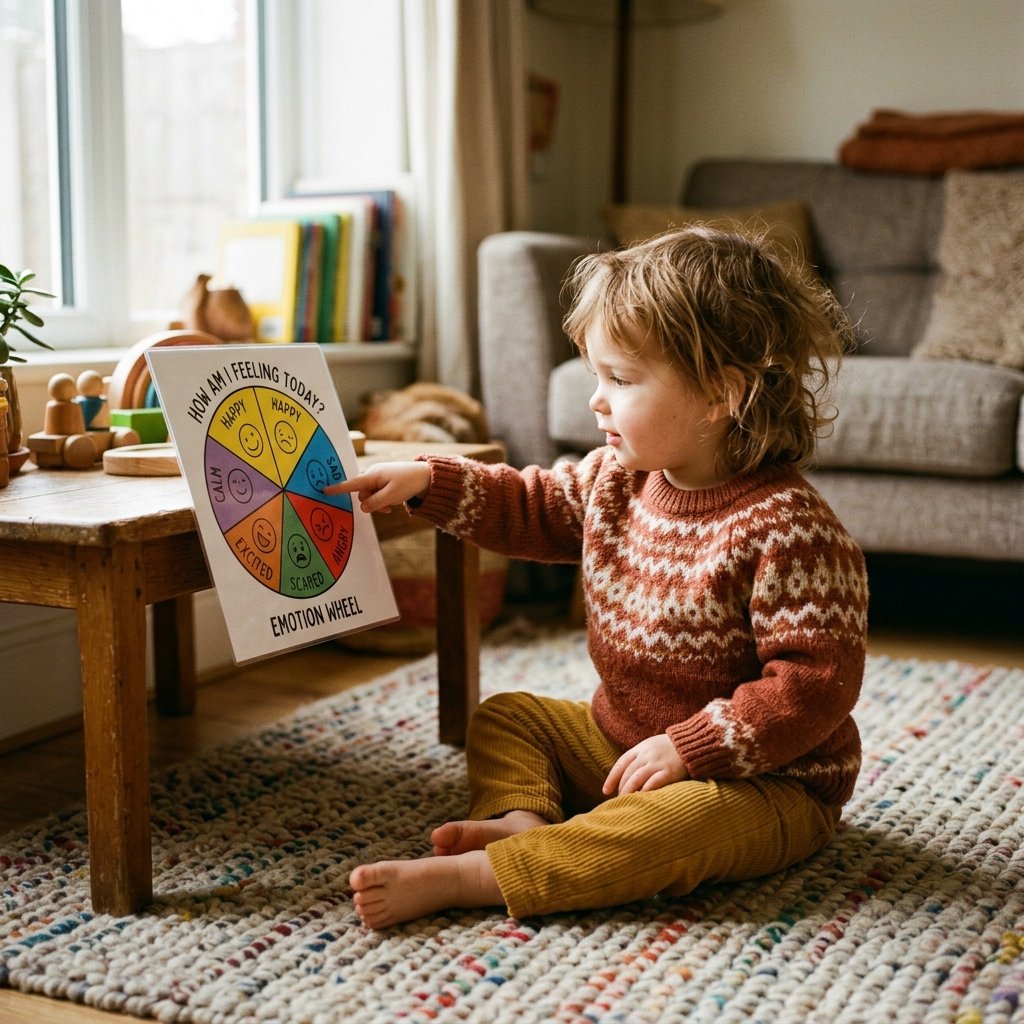
Toddlers feel deeply. They lack the words to say so. When anger strikes, they bite. When sadness hits, they wail. When fear grips them, they cling. They do not lack the feeling; they lack the tool to share it. This gap between feeling a strong emotion and finding the word for it builds frustration. The result is the classic meltdown.
Parents often meet these storms with logic. They ask, “Why are you crying?” A two-year-old cannot answer this. Their prefrontal cortex—the brain part that handles logic and words—is still dark. Their amygdala—the alarm bell of the brain—is ringing loud. They do not need questions. They need a bridge. The emotion wheel is that bridge.
What is an Emotion Wheel?
An emotion wheel is a visual tool. It pairs a clear, basic feeling with a simple face. In its best form for toddlers, it shows core states: happy, sad, mad, scared, surprised, and disgusted. By pointing to a face, a child gives their feeling a shape. They take an abstract storm and make it a concrete thing.
Psychologists use this tool to build emotional literacy. Emotional literacy is the skill to read, name, and manage feelings. Children who learn this early face fewer social hurdles later. They fight less. They share more. They calm down faster.
The Brain Behind the Wheel
To grasp why the wheel works, look at the brain. A toddler’s brain grows faster than at any other point in life. Synapses fire and wire at lightning speed. Yet, the emotional centers outpace the speech centers. A child feels the heat of rage long before they can say the word “angry.”
When a child feels a big emotion, cortisol floods their system. The thinking brain shuts off. You cannot reason with cortisol. But when you give a child a visual cue—a picture of a sad face—you engage the visual cortex. If you ask them to match their feeling to the picture, you force the brain to switch tracks. You pull energy from the alarm bell and route it to the logic center. Naming the feeling tames the feeling.
Why Do Visuals Work Better Than Words?
Words vanish the second you speak them. Pictures stay. When a child is upset, processing sound gets hard. Hearing a parent say, “Use your words,” only adds to the stress. Looking at a chart is quiet. It asks less of a stressed brain. It gives the child the power to point, to choose, and to own their state.
How to Build the Habit: A Step-by-Step Guide
You cannot hand a chart to a crying child and expect magic. You must teach the tool when the child is calm. Here is how to make the emotion wheel work in your home.
1. Start in the Calm
Show the wheel when the child is happy. Point to the smiling face. Say, “This face looks happy. I feel happy when we play blocks. How do you feel?” Make it a game. Let them point. Associate the wheel with safety, not just trouble.
2. Name Your Own Storms
Children watch what you do, not what you say. Model the behavior. If you spill your coffee, walk to the wheel. Point to the angry or sad face. Say, “I dropped my drink. I feel mad. I need to take a deep breath.” You show them that big feelings are normal. You show them that adults have them, too.
3. Catch the Feeling Early
Do not wait for the full meltdown. If you see their brow furrow, or their fists clench, step in. Bring the wheel. Ask, “Are we feeling mad or scared?” Give them a choice between two. A full wheel can overwhelm. Narrow the field.
4. Validate, Do Not Fix
When they point to the sad face, do not rush to make them happy. Say, “You feel sad. That makes sense. We had to leave the park. I would feel sad, too.” Validation drains the emotion. Fixing builds resistance.
Try the Wheel With Your Child
We built a simple, interactive wheel below. Sit with your child. Click a slice. See the face change. Talk about a time you both felt that way. Use this as a starting point to build emotional literacy.
How are we feeling today?
Click a colored slice to name the feeling.
Waiting…
Find the face that matches how you feel.
Happy
What made you smile today?
Sad
It is okay to cry. Do you want a hug?
Mad
Let us take a slow, deep breath together.
Scared
I am right here with you. You are safe.
Silly
Show me your best funny face!
Tired
Is it time to rest our bodies?
How are we feeling today?
Click a colored slice to name the feeling.
Pick a slice
Find the face that matches how you feel.
Happy
What made you smile today?
Sad
It is okay to cry. Do you want a hug?
Mad
Let us take a slow, deep breath together.
Scared
I am right here with you. You are safe.
Silly
Show me your best funny face!
Tired
Is it time to rest our bodies?
Common Mistakes Parents Make
Tools fail when used poorly. Even the best emotion wheel will not stop tears if the timing is wrong. Avoid these three common traps.
Forcing the Issue
If a child is in a full rage, do not push a chart in their face. A brain in fight-or-flight mode cannot process images. Wait out the peak. Sit close. Stay quiet. Once the crying slows to hiccups, bring the wheel. Say, “That was hard. Point to how you felt.”
Telling Them How They Feel
Do not point for them. You may think they are mad, but they might be scared. A child drops a toy and screams. You think anger; they felt surprise, then fear that it broke. If you force your label onto their experience, you teach them to doubt their own gut. Let them point. If they point to “scared” when they look angry, believe them.
Punishing the Feeling
Feelings are not choices. Behaviors are. Never punish a child for pointing to the “mad” face. If they hit their sister, address the hitting, not the anger. Say, “It is okay to feel mad. It is not okay to hit. When you feel mad, hit this pillow, or point to the red face.” Separate the emotion from the action. You must leave room for the storm.
The Long Game: Resilience Through Words
You teach your child to name colors, shapes, and animals. You read books to point out the moon and the stars. You must bring the same rigor to their inner world. The inner world shapes the outer life.
When a toddler learns that anger is just a word—not a fire that will consume them—they gain power. When they see that sadness is a state that comes and goes, they build resilience. They learn that feelings are guests, not residents.
Does This End Tantrums?
No. Nothing ends tantrums. Tantrums are the growing pains of the brain. But the wheel shortens them. It gives the child an exit ramp. Instead of crying until they exhaust themselves, they point, they feel heard, and they move on.
Emotional literacy is not a quick fix. It is a slow build. It takes patience, modeling, and steady nerve. But the payoff is profound. The two-year-old who learns to point to a red face becomes the five-year-old who says, “I am mad,” instead of throwing a block. They become the teenager who talks through grief instead of acting out. They become the adult who knows their own mind.
Start small. Print a chart. Tape it to the fridge. Hang one by their bed. Make the language of feelings as common as talk about the weather. Give them the words, and they will find their way out of the storm.