


A wearable sensor study from New York has shown that a machine can detect the invisible biological signals of an impending behavioural crisis in children with profound autism — up to ten minutes before any human in the room can see it coming.
The classroom at The Center for Discovery in Harris, New York, is arranged with careful, quiet deliberation. At a table sits a 13-year-old student — identified in the research as ‘S09’ — diagnosed with profound autism.
To the teachers and behaviour analysts watching him, S09 appears completely at ease. His hands rest on the table. He is sitting quietly.
On his left ankle, a small sensor band is silently recording what the human eye cannot see. His sympathetic nervous system — the biological alarm system that governs the body’s fight-or-flight response — registers a sharp spike.
The sweat glands beneath his skin begin releasing micro-droplets of moisture. Tiny, rhythmic muscle movements ripple through his limbs.
Ten minutes later, the calm shatters. S09 stands abruptly, his breathing turns heavy, and he clamps both hands tightly over his ears — the visible beginning of a behavioural crisis that, to everyone in the room, appeared to arrive without warning.
It did not. The body announced it ten minutes earlier. No one — until now — had a way to listen.
The Study
A research paper published in the August 2025 volume of the ‘Proceedings of the ACM on Measurement and Analysis of Computing Systems’ describes how a team of researchers built an artificial intelligence system capable of detecting exactly these invisible pre-crisis signals.
The paper — “Prediction of Challenging Behaviors Associated with Profound Autism in a Classroom Setting Using Wearable Sensors” — was co-authored by Yadhu Kartha, Gari D. Clifford, and Hyeokhyen Kwon of the Georgia Institute of Technology and Emory University, alongside Conor Anderson, Jenny Foster, Theresa Hamlin, Johanna Lantz, and Ryan Lay of The Center for Discovery, and Juergen Hahn of the Rensselaer Polytechnic Institute.
Nine children and young adults aged 10 to 21, all diagnosed with profound autism, wore sensor bands during classroom time.
The team collected approximately 110.7 hours of labelled, multimodal wearable data — meaning every recording was tagged to indicate what the child was doing and what behaviour, if any, followed.
The behaviours the system was designed to predict include self-injurious behaviour (SIB) — where a child harms themselves, for example by hitting their own head — aggression toward others, and elopement, which means suddenly running away from a supervised setting.
For families and caregivers, these are among the most frightening and exhausting challenges of daily life with profound autism.
What the Sensors Are Measuring — and Why
Three sensors were used simultaneously, each capturing a different layer of biological information:
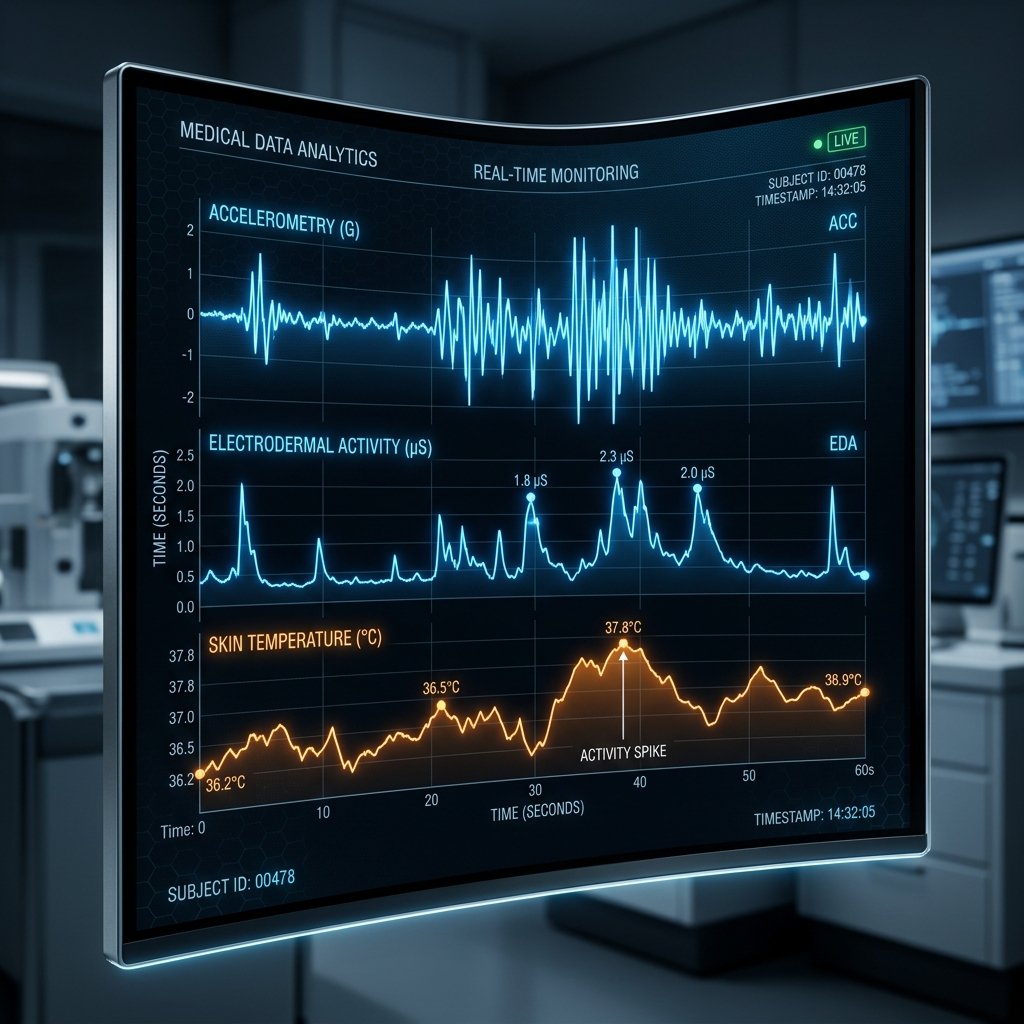
Accelerometry (ACC) measures physical movement — the speed and direction of a limb — in three dimensions simultaneously. Think of it as a precise record of every flicker of motion.
Electrodermal Activity (EDA) — also called galvanic skin response — measures tiny changes in the electrical conductance of the skin caused by sweat gland activity. When the nervous system activates under stress, even before a person is consciously aware of it, sweat glands respond. EDA picks up this invisible arousal signal. It is the same principle behind a polygraph test, but used here in a clinical, non-judgmental way.
Skin Temperature tracks subtle thermal changes caused by the body redirecting blood flow during stress — a process called peripheral vasoconstriction (the narrowing of blood vessels near the skin surface), which causes the skin to cool slightly as the body prepares for a threat response.
The reason all three are needed together is that each tells a different part of the story. A child moving quickly could be playing joyfully or entering crisis. EDA and temperature changes add the biological context that tells the AI which is which.
One technical challenge the researchers had to solve: these signals do not all arrive at the same time. Accelerometry captures movement instantly.
But autonomic signals — EDA and temperature changes — can lag behind a physical trigger by several seconds or even minutes, because the body’s stress response is gradual.
The AI’s architecture was specifically designed to align these mismatched timelines, essentially synchronising signals from three different biological clocks into a single coherent picture.
How the AI Was Built
Training an AI for extreme behaviours is technically challenging. Deep learning systems — the kind of AI used here — normally require millions of data points to function reliably.
But obtaining enough labelled examples of severe behavioural crises in children is both difficult and ethically complex.
The researchers solved this using a technique called self-supervised learning, or SSL.
At its core, the AI — called HarNet5 — was first trained not on autism data at all, but on the Capture-24 dataset: over 3,000 hours of wearable sensor data from ordinary people, drawn from the UK Biobank, which contains over 700,000 person-days of movement recordings.
By learning what normal human movement looks and feels like across hundreds of thousands of people, HarNet5 developed a general, robust understanding of physical activity — the equivalent of learning to read before being asked to analyse a specific document.
Only then was the AI fine-tuned on the specialist data collected at The Center for Discovery, allowing it to apply its broad physical intelligence to the narrow, critical question of predicting crisis.
Opening the Black Box
One of the most common — and legitimate — criticisms of AI in healthcare settings is that it functions as a “black box”: it delivers a prediction but cannot explain its reasoning. For a parent or teacher, that is not good enough. If a device on a child’s ankle sends an alert, they need to know why.
The researchers addressed this using two explainability tools:
MM-SHAP (Shapley Additive exPlanations — a method borrowed from game theory that calculates exactly how much each variable contributed to a final outcome) was used to measure each sensor’s contribution to the AI’s predictions.
Physical movement, recorded via accelerometry, dominated: it contributed an average of 0.90 out of a possible 1.0 to the AI’s decisions. EDA contributed 0.08, and skin temperature 0.02.
This does not mean temperature and EDA are unimportant — they provide the critical context that stops the system from misreading vigorous play as an incoming crisis.
Grad-CAM (Gradient-weighted Class Activation Mapping — a visualisation tool that highlights which parts of the input data the AI was paying attention to when it made a decision) was used to map exactly which moments in the sensor recordings the AI focused on.
When these maps were overlaid on the raw data, they showed the AI’s attention clustering around subtle, rhythmic acceleration bursts and autonomic shifts occurring minutes before any visible behaviour — precisely the invisible pre-storm signals that S09’s teachers could not see.
What the Numbers Actually Mean — and the Hard Ethical Question
Here is where the technology hits a wall that no engineer can fully design around.
At a 10-minute prediction horizon — meaning the system issues an alert 10 minutes before a predicted crisis — the AI achieved an AUC-ROC of 0.78. AUC-ROC is a standard measure of a classification system’s overall ability to distinguish between two outcomes (crisis vs. no crisis), where 1.0 is perfect and 0.5 is no better than chance. A score of 0.78 is clinically meaningful.
But the breakdown of that score contains a tension that every family considering this technology deserves to understand clearly:
Recall: 0.55 — the system catches approximately 55% of actual crises. Four in ten real events are missed entirely.
Precision: 0.31 — of all the alerts the system sends, only 31% correspond to an actual crisis. Two out of every three alerts are false alarms.
How Each Sensor Performs Alone vs. Together
| Sensor / Configuration | Model Used | AUC-ROC | Precision | Recall | F1 Score |
|---|---|---|---|---|---|
| Accelerometry only | HarNet | 0.778 | 0.276 | 0.595 | 0.608 |
| Electrodermal Activity only | Conv. Autoencoder | 0.620 | 0.586 | 0.861 | 0.604 |
| Skin Temperature only | CNN-Based Model | 0.624 | 0.588 | 0.854 | 0.609 |
| All sensors combined (fused) | Naive Concatenation (MLP) | 0.793 | 0.300 | 0.576 | 0.633 |
*All metrics represent binary detection performance with 95% confidence intervals as reported in the clinical trial.
This creates a genuine ethical dilemma — one the research community is actively debating. On one side: as Emily Bourne and colleagues at Belmont University note in their Spring 2026 qualitative study on elopement in children with autism, behaviours like sudden running away place children “at risk for serious harm, including drowning or traffic injury.”
A missed crisis can be catastrophic. From this perspective, a high false-alarm rate is a defensible price to pay for a system that catches more than half the events it would otherwise miss.
On the other side: caregivers and special educators already operate under what researchers call “chronic hypervigilance” — a state of exhausting, continuous alertness that takes a severe toll on mental and physical health.
Joy S. Pollard and Scott S. Hall of the Stanford University School of Medicine, writing in their May 2026 paper in JMIR Research Protocols on the COACH (Caregiver Outreach for Autism Coaching at Home) trial, describe how managing these daily safety demands places a massive emotional burden on families.
If a wearable device triggers constant false alarms, exhausted parents and teachers “may develop ‘alert fatigue,’ progressively ignoring notifications and undermining the system’s utility.” Sayyed Ali Samadi of Ulster University, in his October 2025 study on elopement in low-resource settings, documents how these behaviours are already deeply linked to “heightened sense of stress, trauma, and an increase in the risk of family conflicts.” An over-sensitive AI device risks adding to that baseline rather than relieving it.
There is no clean answer. The technology works. It is imperfect. And how families and schools choose to use it — with what thresholds, in what contexts, with what support structures — will matter as much as the algorithm itself.
What to Do With Ten Minutes: A Practical Guide for Caregivers
When an alert arrives, the countdown begins. The following protocol is adapted from the environmental safety and Skill-Based Treatment (SBT) guidelines used in the Stanford COACH trial. It is designed not to alarm, but to prepare.
Minutes 10 to 8 — Secure the Physical Space
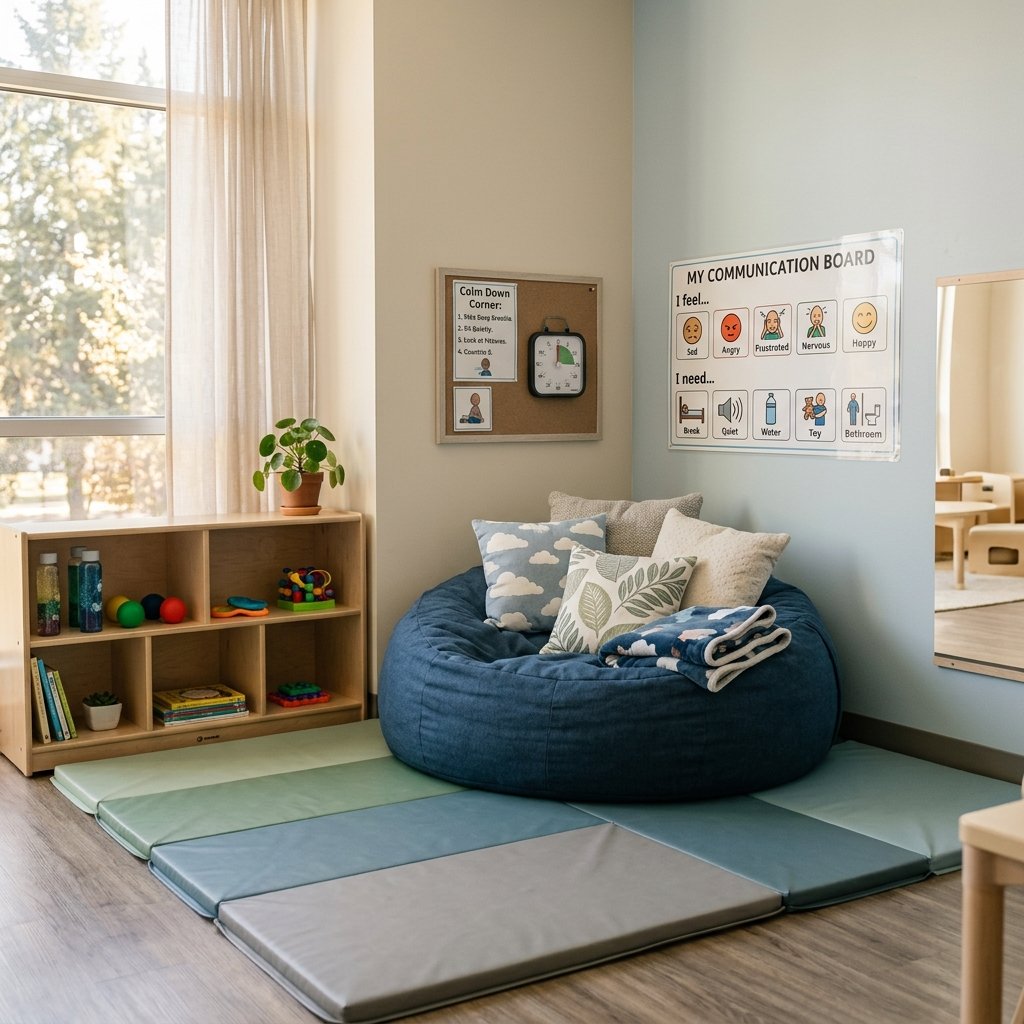
Quickly check that the immediate area — roughly a 6×6 foot zone around the child — is clear of anything that could cause injury: glass, sharp objects, heavy mugs, breakable items. Position soft cushions or gym mats nearby as non-threatening protective barriers. If you are a staff member, secure long hair, cover arms, and remove dangling lanyards or jewellery.
Minutes 8 to 5 — Reduce Sensory and Cognitive Pressure
Pause all academic instruction, tasks, or adult-directed activities immediately. Lower your voice. Slow your speech. Model calm, visible breathing — the body language of de-escalation. Do not crowd the child. Offer immediate, unrestricted access to their favourite toys, sensory items, or preferred activities, without requiring any compliance in return.
Minutes 5 to 0 — Support Communication
Place a laminated communication card — such as one labelled “my way” or “break” — within the child’s direct reach. Use gentle, least-to-most prompting to guide them toward expressing what they need, whether through the card, a picture board, or an AAC (Augmentative and Alternative Communication) device. The moment they communicate, grant the request immediately. This creates a predictable, safe loop — establishing that communication works, and that there is no need to elope, strike out, or self-injure to make a need known.
The ten-minute window this AI creates is not a cure. It is a tool — one that shifts the dynamic from reactive restraint to proactive, compassionate preparation. For the families of S09 and the thousands of children like him, that shift — however imperfect — may be the most important thing technology has offered them yet.