

Quick Summary
- A comprehensive study of 385 management educators in India reveals that alexithymia—the inability to identify and process one’s own emotions—is a primary driver of academic burnout.
- When educators suppress their emotional reality to meet escalating institutional demands, they are more likely to experience severe exhaustion and physiological breakdown.
- The data points to a “high-performing trap” where outward productivity masks deep emotional exhaustion, and a “detachment spiral” where emotional disconnect degrades teaching quality.
- Institutions must move beyond mere workload recalibration and implement structured emotional intelligence and cognitive-behavioral support frameworks.
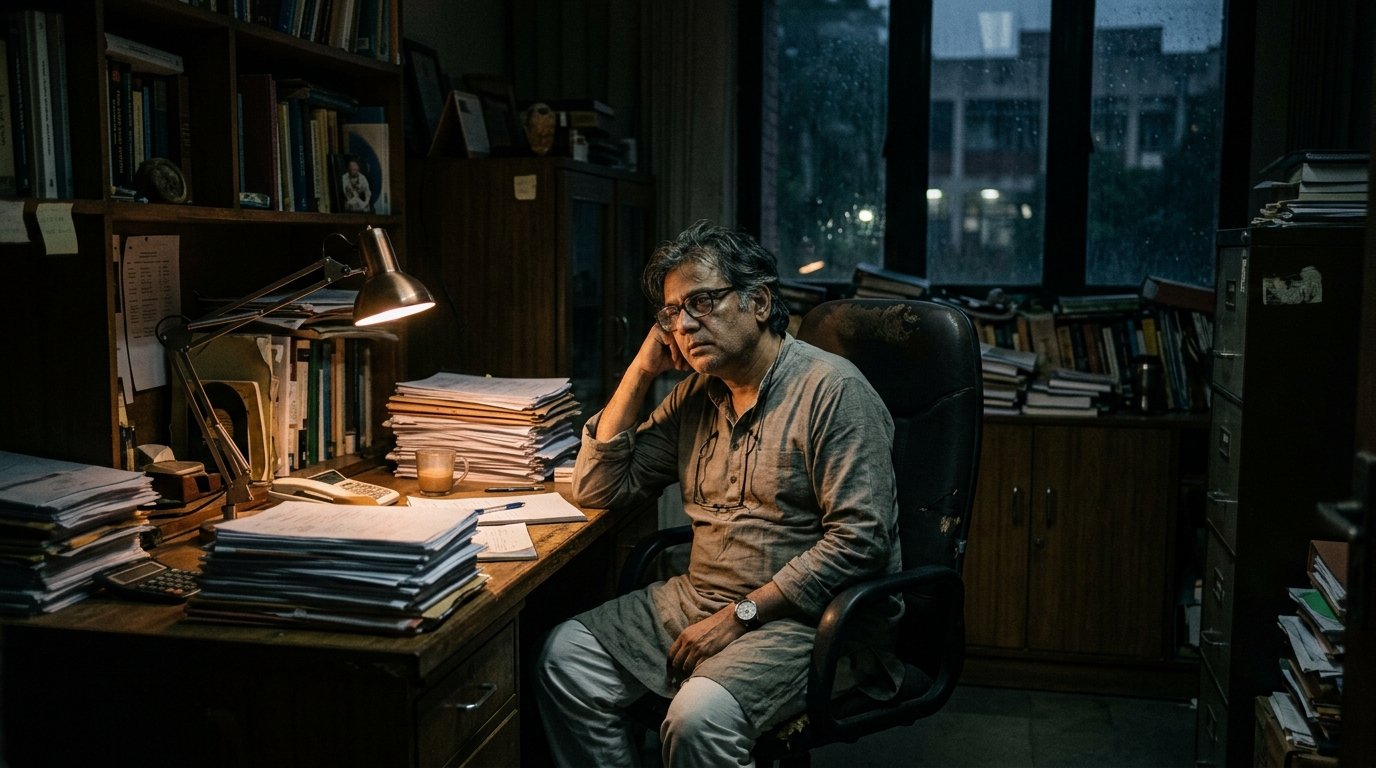
For many teachers , professional exhaustion does not begin with a ‘breaking point’ or a sudden collapse in the middle of a lecture hall. It arrives far more discreetly, settling into the seams of the working day: another midnight deadline quietly met through sheer endurance, another three-hour seminar delivered on empty reserves, another administrative meeting endured in silence while swallowing rising frustration, anxiety, and physical fatigue.
In India’s business schools, where business faculty are expected to juggle rigorous teaching schedules, produce peer-reviewed publications, mentor ambitious graduate students, handle complex committee duties, and meet escalating institutional key performance targets, that emotional quietude has long been treated as professional composure.
Yet a comprehensive empirical investigation suggests that this very silence may be exacting a severe psychological toll. The research indicates that a widely overlooked psychological construct is quietly accelerating professional deterioration across higher education: alexithymia, a clinical term denoting significant difficulty in identifying, describing, and cognitively processing one’s own emotions.
The study, conducted by Sneha Patalay and Bandaru Srinivasa Rao of the Department of Management Studies at Vignan’s Foundation for Science, Technology & Research in Andhra Pradesh, offers a granular look into the internal emotional landscape of management faculty. Published in the International Journal of Special Education, the investigation surveyed 385 management educators across India to assess how variations in emotional processing correlate with distinct clinical subtypes of burnout and tangible metrics of job performance.
Their findings present a sobering picture of contemporary academia: instructors who lack the cognitive tools or emotional vocabulary to interpret what they feel are markedly more vulnerable to severe, multidimensional burnout. Some push themselves into relentless overwork until physiological systems fail. Others drift into pervasive professional apathy, trapped in unvarying routines. Still others succumb to complete institutional alienation, stripped of agency and disengaging from their duties altogether.
The Weight of Emotional Labor in Higher Education
The idea that teaching demands heavy emotional labor is not new. Half a century ago, in 1976, social psychologist Christina Maslach laid the groundwork for modern burnout theory by identifying “helping professions” as uniquely hazardous to psychological wellbeing. Maslach argued that roles reliant on continuous, intense interpersonal engagement inherently generate continuous emotional strain.
While Maslach’s framework initially centered on healthcare workers and social service providers, Patalay and Rao situate India’s rapidly growing management education sector directly within that global lineage. Over the past two decades, Indian business education has experienced rapid commercialization and global integration, multiplying institutional expectations. Faculty members are no longer merely classroom instructors; they operate as researchers, corporate consultants, pastoral mentors, and administrative operators.
| THE TRIAD OF ALEXITHYMIA (Toronto Alexithymia Scale / TAS-20) | ||
|---|---|---|
| Difficulty Identifying Feelings (Mean: 2.44) | Difficulty Describing Feelings (Mean: 2.93) | Externally Oriented Thinking (Mean: 3.42) |
| Correlates with Under-Challenged Burnout & Drops in Task/Context Performance | Reflects inability to verbalize stress; somatic manifestations follow | Drives Frenetic Burnout: Tunnel-vision focus on tasks masks deep exhaustion |
A growing body of international scholarship has reinforced these dynamics:
- In 2025, researchers Scarzello and Prino evaluated Italian pre-school teachers, discovering that alexithymia directly predicted emotional weariness and depersonalization while significantly undermining feelings of personal accomplishment.
- In China, a landmark 2021 study by Zhang X and colleagues surveyed 2,684 village doctors, revealing that 65.2 percent met the clinical threshold for burnout, with alexithymia standing out as a primary predictor.
- In 2020, Saeidi and collaborators demonstrated that Iranian hospital nurses possessing elevated alexithymia scores suffered from significantly heightened rates of acute burnout.
- In 2019, Romano and colleagues established that baseline anxiety acted as a critical mediating bridge connecting alexithymia to academic weariness and declining student performance.
Patalay and Rao bridge these cross-cultural insights, applying the lens directly to the pressure-cooker environment of Indian business school faculties.

Anatomy of an Unspoken Condition
Alexithymia is not classified as a psychiatric illness or a clinical mood disorder. Rather, psychologists define it as a specific deficit in emotional cognitive processing.
An individual with pronounced alexithymic tendencies does not lack emotions; instead, they struggle to register, differentiate, and articulate those emotions. Severe anxiety may be experienced purely as somatic distress—a sudden spike in heart rate, chronic gastrointestinal pain, muscle tightness, or overwhelming exhaustion—without the conscious awareness that these sensations stem from psychological worry. A faculty member may recognize profound fatigue without realizing it is driven by unresolved professional resentment, or note physical tension while remaining blind to underlying fear of institutional evaluation.
To measure this construct, Patalay and Rao utilized the Toronto Alexithymia Scale (TAS-20), a globally recognized 20-item diagnostic instrument evaluating three core dimensions:
- Difficulty Identifying Feelings (DIF): The inability to distinguish between specific emotional states and the bodily sensations of emotional arousal.
- Difficulty Describing Feelings (DDF): The persistent challenge of finding words to communicate internal emotional states to others.
- Externally Oriented Thinking (EOT): A cognitive style focused entirely on external events, pragmatic tasks, and concrete details, deliberately bypassing introspection or inner emotional reality.
| Psychometric Dimension | Mean Score | Standard Deviation (SD) |
|---|---|---|
| TAS-20: Total Alexithymia | 8.79 | 1.94 |
| • Difficulty Identifying Feelings (DIF) | 2.44 | 0.83 |
| • Difficulty Describing Feelings (DDF) | 2.93 | 0.62 |
| • Externally Oriented Thinking (EOT) | 3.42 | 0.49 |
| BCSQ-36: Total Burnout | 27.24 | 8.45 |
| • Frenetic Subtype | 11.16 | 2.66 |
| • Under-Challenged Subtype | 7.87 | 2.84 |
| • Worn-Out Subtype | 8.39 | 2.95 |
Across the 385 validated responses, the cohort recorded a mean total alexithymia score of 8.79. When broken down by subscale, Externally Oriented Thinking emerged as the single highest dimension at a mean of 3.42, outpacing Difficulty Describing Feelings and Difficulty Identifying Feelings.
This pattern paints an instructive portrait of the academic workplace: when confronted with escalating systemic pressure, educators routinely retreat into functional task orientation, methodically grading papers, revising syllabi, and checking administrative boxes while completely suppressing their internal emotional world.
Deconstructing the Three Faces of Burnout
Rather than treating burnout as a monolithic condition of fatigue, Patalay and Rao structured their inquiry around a multidimensional burnout subtype framework. The researchers categorized professional exhaustion into three distinct clinical manifestations:
| 1. Frenetic Subtype (Mean: 11.16) | 2. Under-Challenged Subtype (Mean: 7.87) | 3. Worn-Out Subtype (Mean: 8.39) |
|---|---|---|
| Driven by ambition, overload, and heavy involvement. Channels anxiety into working longer hours. | Driven by monotony, lack of institutional mobility, and persistent boredom. Yields emotional detachment and professional stalling. | Driven by systemic neglect, perceived powerlessness, and loss of control. Leads to withdrawal. |
The clear dominance of the frenetic profile highlights an academic ecosystem where frantic over-commitment, unmanaged ambition, and constant overwork serve as default responses to institutional stress.
The Demographics of Exhaustion
A closer look at the sample reveals that emotional processing deficits and burnout vulnerabilities are distributed unevenly across gender, age brackets, and career stages. Male faculty members exhibited marginally higher overall burnout ratings (27.80) than their female peers (26.84), accompanied by slightly elevated alexithymia scores.
| Variable | Sample (N) | Percentage (%) | Burnout (M) | Alexithymia (M) |
|---|---|---|---|---|
| GENDER | ||||
| • Male | 226 | 58.7% | 27.80 | 8.81 |
| • Female | 159 | 41.3% | 26.84 | 8.76 |
| AGE COHORTS | ||||
| • 20–25 Years | 14 | 3.6% | 28.06 | 9.30 |
| • 26–30 Years | 45 | 11.7% | 26.77 | 9.34 |
| • 31–35 Years | 79 | 20.6% | 28.41 | 8.90 |
| • 36–40 Years | 77 | 20.0% | 28.07 | 8.87 |
| • 41–45 Years | 68 | 17.6% | 26.71 | 8.64 |
| • 46–50 Years | 37 | 9.7% | 27.78 | 8.59 |
| • > 50 Years | 65 | 16.8% | 26.38 | 8.60 |
| YEARS OF EXPERIENCE | ||||
| • 1–5 Years | 77 | 20.0% | 27.75 | 8.88 |
| • 6–10 Years | 74 | 19.2% | 27.32 | 8.85 |
| • 11–15 Years | 90 | 23.3% | 28.16 | 8.75 |
| • 16–20 Years | 50 | 13.0% | 28.09 | 8.90 |
| • > 20 Years | 94 | 24.5% | 26.23 | 8.50 |
Generational and career milestones yielded more pronounced variations. Alexithymia peaked sharply among the youngest cohorts: educators aged 26 to 30 recorded the sample’s highest alexithymia score at 9.34. However, burnout followed a different trajectory, peaking in mid-career. The highest absolute burnout was concentrated among faculty aged 31 to 35 (mean = 28.41), closely followed by those aged 36 to 40. These critical decades coincide with intense pressures surrounding tenure applications, doctoral completion, research targets, and heightened family responsibilities.
By contrast, senior educators aged 50 and above reported the lowest burnout levels across the study, alongside an alexithymia mean of 8.60. This marked drop among long-serving professors points to two plausible workplace realities: either senior academics develop refined psychological boundaries and coping mechanisms over time, or higher education experiences a natural survivor bias, wherein individuals unable to process unrelenting stress leave the profession early.
Statistical Links: The High-Performing Trap and the Downward Spiral
To map the precise structural mechanics linking emotional processing, burnout subtypes, and performance metrics, the researchers executed extensive multi-stage linear regression models. The models reveal two divergent psychological pathways operating within university faculties.
| Predictor Variable | Unstd (B) | SE | Beta (β) | t-Stat | p-Value | Model Fit |
|---|---|---|---|---|---|---|
| STAGE 1A: PREDICTING EXTERNALLY ORIENTED THINKING (EOT) | ||||||
| Ambition | 0.491 | 0.092 | 0.274 | 5.355 | 0.000 | R=0.262, R²=0.069, F=28.247 |
| Overload | 0.339 | 0.105 | 0.168 | 3.227 | 0.001 | R=0.184, R²=0.034, F=13.391 |
| Involvement | 0.527 | 0.076 | 0.336 | 6.901 | 0.000 | R=0.300, R²=0.090, F=37.931 |
| STAGE 1B: EOT PREDICTING PERFORMANCE METRICS | ||||||
| Task Performance | 0.511 | 0.073 | 0.323 | 7.000 | 0.000 | — |
| Contextual Performance | 0.480 | 0.079 | 0.289 | 6.077 | 0.000 | — |
| STAGE 2A: PREDICTING DIFFICULTY IDENTIFYING FEELINGS (DIF) | ||||||
| Indifference | 0.380 | 0.070 | 0.342 | 5.420 | 0.000 | R=0.396, R²=0.156, F=71.024 |
| Lack of Development | 0.255 | 0.075 | 0.221 | 3.380 | 0.001 | R=0.296, R²=0.088, F=36.867 |
| Boredom | 0.372 | 0.070 | 0.328 | 5.285 | 0.000 | R=0.419, R²=0.176, F=81.618 |
| STAGE 2B: DIF PREDICTING PERFORMANCE METRICS | ||||||
| Task Performance | -0.325 | 0.043 | -0.346 | -7.507 | 0.000 | — |
| Contextual Performance | -0.279 | 0.047 | -0.284 | -5.969 | 0.000 | — |
| STAGE 3: DIRECT PREDICTORS OF PERFORMANCE DIMENSIONS | ||||||
| Ambition -> Task Perf | 0.198 | 0.040 | 0.223 | 4.895 | 0.000 | — |
| Ambition -> Context Perf | 0.219 | 0.040 | 0.236 | 5.518 | 0.000 | — |
| Involve -> Task Perf | 0.524 | 0.049 | 0.518 | 10.788 | 0.000 | — |
| Involve -> Context Perf | 0.594 | 0.048 | 0.561 | 12.454 | 0.000 | — |
| Lack of Control -> Task | -0.110 | 0.041 | -0.135 | -2.687 | 0.008 | — |
The High-Performing Trap: Externally Oriented Coping
In the first pathway, the subscale of Externally Oriented Thinking was heavily driven by the components of frenetic burnout. Ambition, overload, and heavy involvement all served as significant positive predictors. Crucially, this externally oriented coping style demonstrated strong positive correlations with short-term workplace output, positively predicting both Task Performance and Contextual Performance.
This finding uncovers what organizational psychologists term a dangerous institutional illusion. Faculty who respond to stress by suppressing self-reflection and fixating entirely on external tasks often appear to be model employees. They meet administrative targets, publish papers, and take on departmental service, masking their growing emotional exhaustion beneath outward productivity until their physical or psychological reserves suddenly give out.
The Detachment Spiral: Impaired Emotional Identification
The second pathway produces immediate damage to both the individual and the institution. The inability to decode internal emotional states (Difficulty Identifying Feelings) was strongly linked to under-challenged burnout. Indifference, lack of professional development, and boredom emerged as powerful predictors of this deficit.
Unlike externalized coping, this emotional disconnect directly degraded academic performance. When educators cannot identify the emotional roots of their boredom and lack of agency, they disengage entirely. Classroom delivery becomes mechanical, peer collaboration ceases, and professional paralysis takes over.
Re-Engineering the Academic Infrastructure
The policy implications of Patalay and Rao’s findings extend well beyond traditional human resources recommendations. Across higher education, conventional institutional responses to faculty burnout typically focus on structural adjustments: trimming committee sizes, altering teaching timetables, or purchasing digital workflow tools.
While workload recalibration remains necessary, the empirical data demonstrates that operational fixes alone will not solve the underlying crisis. If universities reduce task loads while leaving faculty without the psychological skills to identify, process, and articulate professional stress, burnout will continue to manifest across departments in different forms.
Recommended Institutional Intervention Channels
- Structured Emotional Intelligence (EQ) Workshops
- Cognitive-Behavioral Support Systems & Counseling Services
- Integrated Mindfulness & Somatic Awareness Programs
- Cultural Decoupling of “Overwork” from “High Performance”
The researchers argue for deliberate, institutional interventions across business schools, emphasizing structured programs incorporating mindfulness-based stress reduction, emotional intelligence training, and accessible cognitive-behavioral support frameworks.
Such initiatives are not mere wellness perks; they target the specific cognitive pathways identified in their models. Structured introspective training helps reduce alexithymic tendencies by encouraging faculty to recognize early somatic warnings of stress, build emotional self-awareness, and replace silent overwork with sustainable self-regulation. Ultimately, the study calls for a fundamental reassessment of how universities value academic labor. Their emotional and psychological health forms an essential pillar of higher education’s institutional infrastructure.