

GANDHINAGAR–Ever found yourself staring at a sleeping baby, wondering what magical formula makes them drift off so peacefully (or, let’s be real, desperately wishing they would)? Beyond just cute snores and tiny yawns, there’s a whole universe of microscopic life inside their little tummies that might be whispering secrets to healthier sleep.
We all know how crucial sleep is, especially for infants whose brains are rapidly developing. It’s widely understood that the gut microbiome – that vast community of bacteria living in our intestines – plays a vital role in everything from our immune system to our metabolism.
There’s even an emerging concept called the microbiota-gut-brain axis, suggesting a two-way communication highway between our digestive system and our brain.
Infancy is a particularly critical period for both establishing this gut microbiome and developing healthy sleep patterns. We’ve seen evidence linking gut bacteria to sleep in adults and school-aged children, and even hints that certain bacterial byproducts, like propionate (produced by beneficial Bifidobacteria often promoted by human milk oligosaccharides), might influence how long babies’ sleep.
The idea is compelling: a healthy gut could mean a well-rested baby, supporting their overall development.
But here’s the kicker…
Despite this growing understanding, the exact role of gut bacteria in modulating infant sleep has remained largely a mystery, surprisingly underexplored until now.
Most previous research hasn’t dived deep enough into this crucial early-life period, often lacking the high-frequency, continuous data needed to truly see the daily rhythms and rapid changes in a baby’s gut and sleep.
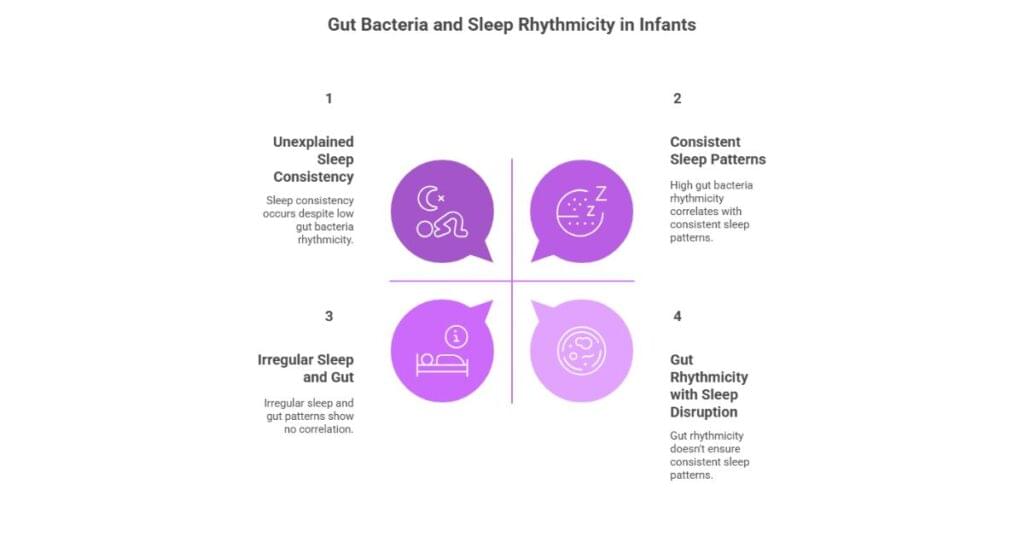
This recent study aims to fill that gap, and what they found adds layers of complexity to this fascinating connection. For instance, while some infants showed daily rhythms in their gut bacteria, these weren’t directly or significantly associated with sleep rhythmicity in the way researchers might have predicted.
Even more surprisingly, the study revealed that an infant’s immediate sleep or feeding history – like how long they’d been awake or when they last ate – had no significant impact on their gut microbiota diversity. This is quite different from what’s observed in adults, where fasting can influence microbial diversity.
The researchers also looked at how “volatile” or unstable a baby’s gut bacterial community was over 48 hours, and this temporal volatility wasn’t significantly associated with differences in sleep rhythmicity or overall sleep quality. And while there were positive trends, simple measures of gut diversity like how many different types of bacteria were present, didn’t directly predict overall sleep quality. This suggests the picture is more nuanced than just “more diversity equals better sleep”.
Therefore, how did this study untangle these complexities, and what did they discover?
To address these unknowns, a team of researchers from leading institutions, including Fannie Kerff, Anja Adamov, Serafina Plüss, and Nicholas A. Bokulich from the Department of Health Sciences and Technology, ETH Zurich, Switzerland; Christophe Mühlematter, Deborah Fast, and Salome Kurth from the Department of Psychology, University of Fribourg, Switzerland (with Salome Kurth also affiliated with the Department of Pulmonology, University Hospital Zurich, Switzerland); and Petra Zimmermann from the Faculty of Health Sciences and Medicine, University of Lucerne and Department of Paediatrics, Children’s Hospital of Central Switzerland, and the Department of Community Health, Faculty of Science and Medicine, University of Fribourg, Switzerland, embarked on a first-of-its-kind observational longitudinal study. A pre-print of the research has been published in bioRxiv. (Scroll to Link Below to access the research paper)
This research, funded by the Olga Mayenfisch Foundation and the Swiss National Science Foundation, followed 20 healthy infants, assessing them at 2, 4, and 6 months of age, with data collection spanning from May 2023 to April 2024.
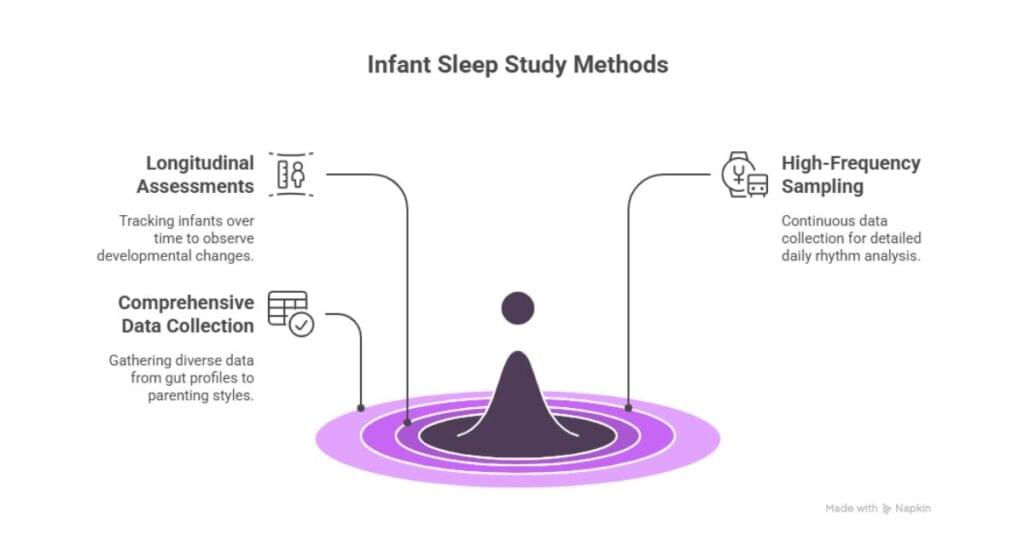
What made this research truly unique was its methodological strengths
Longitudinal Within-Subject Assessments:
Tracking the same infants over several months allowed them to observe developmental trajectories.
High-Frequency, Continuous Sampling:
At each age, they performed continuous within-subject sampling over 48 hours, collecting multiple stool samples and using wearable actimetry (similar to a smartwatch for babies) for objective sleep data. This “high-resolution view” is rare and crucial for understanding daily rhythms.
Comprehensive Data Collection:
Beyond gut microbiota profiles (analyzed using 16S rRNA gene sequencing), they measured gut melatonin levels, objective sleep metrics (like the Circadian Function Index, or CFI, for sleep rhythmicity), subjective parent-reported sleep diaries and questionnaires (like the Brief Infant Sleep Questionnaire, BISQ, used to create a “babySQUID” score for sleep quality), and even assessed parenting style (using the Baby Care Questionnaire, BCQ) and infant behavioral development (using the Ages and Stages Questionnaire, ASQ).
All analyses were rigorously controlled for potential confounders like age, sex, feeding history, parenting style, and infant behavioural developmental stage.
Here’s what their detailed approach revealed about the intricate links between a baby’s gut and their sleep
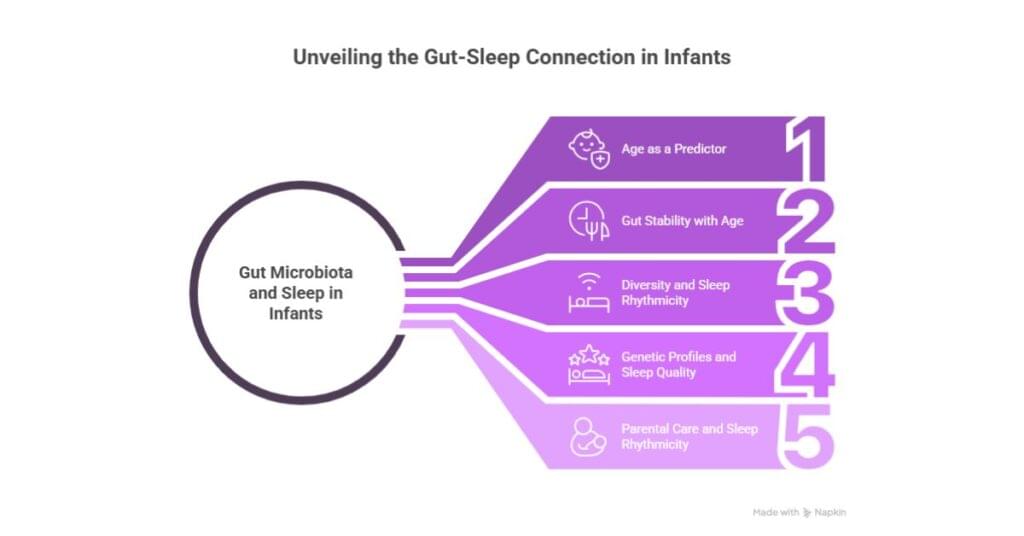
Age is the Master Predictor:
The study confirmed that age was the strongest predictor for both gut microbiota diversity and gut melatonin concentrations. As babies get older, their gut flora naturally becomes more diverse, and their gut melatonin levels increase.
Guts Get More Stable with Age:
In line with this maturation, older infants had lower microbiome temporal volatility, meaning their gut bacterial communities became less variable and more stable over 48 hours. Female infants also showed trends of having less volatile gut microbiomes.
Diversity Fuels Sleep Rhythmicity:
Despite the surprising lack of direct rhythmicity association, a significant and promising finding was that infants with higher alpha diversity (a measure of microbial variety) had more robust sleep rhythmicity, as quantified by the CFI. This suggests that a richer gut environment is linked to more consistent, stable daily sleep-wake patterns.
Beyond Simple Diversity for Sleep Quality:
While overall gut diversity didn’t directly predict sleep quality, when the researchers used a more advanced technique called “k-merization” (which analyses specific genetic sequences of bacteria), they were able to predict sleep quality with moderate accuracy (63.3%). This suggests that it’s not just the number of different types of bacteria present, but rather the specific composition and genetic profiles of those bacteria that may influence sleep quality.
It Takes a Village (and a Good Parent!):
The study also highlighted the importance of a baby’s environment. Beyond gut diversity, a more “attuned” caring style from parents (being responsive to infant cues) and a higher infant developmental score were associated with stronger sleep rhythmicity. This reinforces that a nurturing environment is crucial for healthy sleep development.
So, why is this important for you ?
This study provides a foundational understanding of the intricate, real-time links between the gut microbiome and sleep-wake rhythm maturation in infancy. It confirms that the connection is real, even if it’s more complex than simply “more of this bacterium equals better sleep”.
The insights open up promising new avenues for targeted interventions, such as specialised dietary strategies or even microbiota-based therapies that could support healthy sleep development in infants.
Understanding a baby’s gut health could help guide personalised approaches to promote better sleep, which in turn is vital for their overall neurodevelopment.
While this was a pilot study and further research with larger sample sizes and studies investigating causal mechanisms is needed, this work represents a significant leap forward. It indicates that looking after the tiniest inhabitants of our bodies can have significant impacts on our most fundamental rhythms, right from the very beginning of life.